
Django · Node.js · React
Web Development
Build useful websites and connected web applications, from company information to customer portals and operational systems. Choose the interface, architecture and technology around the people using them.
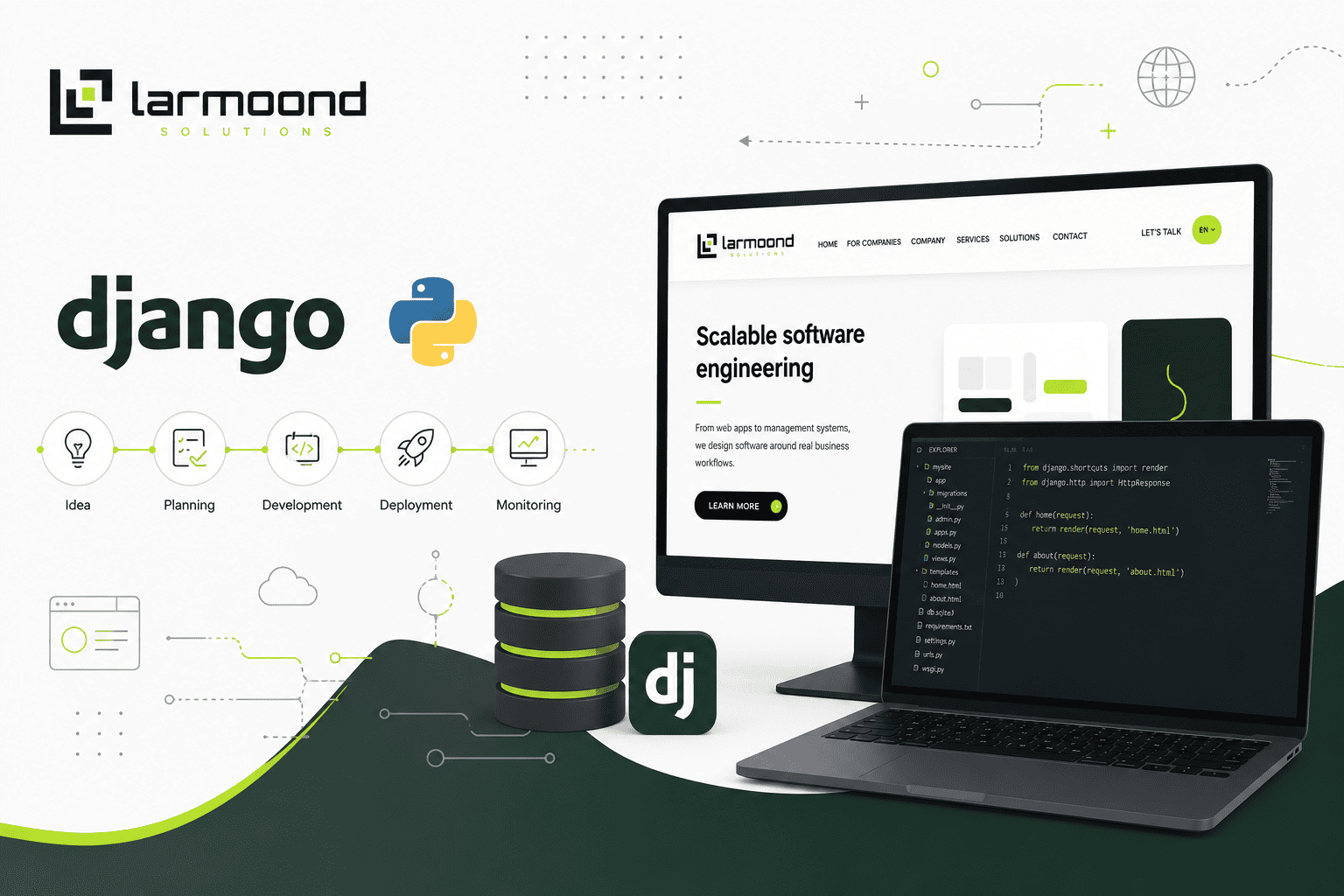
Django · Node.js · React
The service
What does web development include?
A web project connects a useful experience with the rules and information behind it.
A website can introduce an organization, explain services and collect enquiries. A web application lets people complete tasks: manage records, place orders, approve requests or follow progress through a browser.
Development covers understanding those tasks, designing screens, building server logic, connecting information, testing and preparing the application for use. Content, accessibility and ongoing operation belong in the plan from the beginning.

What you can build
Applications shaped around real tasks
These are general possibilities. The features and rules of each system need their own definition.
Company and service websites
Clear information, multilingual content, enquiry forms and manageable pages that help visitors understand an organization and take the next step.
Customer and staff portals
Accounts, documents, requests and status tracking, with access limited to the information each person is entitled to use.
Commerce and bookings
Catalogues, orders, availability, appointments and payment integrations, including cancellation, stock and confirmation rules.
Operational systems
Workflows for records, approvals, tasks and reports, connecting the people responsible for each stage.
Learning and registration
Course information, enrolment, learning materials and progress tracking according to the intended teaching process.
Subscription products
Online services with organization accounts, plans and recurring access, supported by deliberate billing and data separation rules.
How it works
Four parts working together
The visible page is one part of the system. Clear boundaries help keep information and decisions consistent.
Frontend: the user experience
Pages, navigation, forms and interactive controls guide the user. Useful feedback explains loading, errors and completed actions.
Backend: rules and permissions
The server validates requests, checks access and applies business rules. Hiding a button in the browser does not protect the underlying action.
Database: connected information
Structured records and relationships keep information organized. Constraints, transactions and planned schema changes help preserve consistency.
API: agreed communication
An API defines how interfaces or other systems exchange data. Authentication, validation and documented responses are part of that agreement.
Django, Node.js and React
Choose the right role for each technology
These tools have different responsibilities. A project does not need all three.
Django: a Python web framework
Django brings reusable tools for database models and queries, user authentication, forms and staff administration. Its protections help address common web risks when used correctly. Application-specific permissions, workflows and reports still need design and testing.
Node.js: JavaScript on the server
Node.js runs JavaScript outside the browser. Its asynchronous input and output model supports network services and APIs. Frameworks and libraries provide additional structure. Compute-heavy work needs suitable handling; a runtime name alone does not make every application faster.
React: an interactive interface
React organizes interfaces into reusable components that respond to data and user actions. It can support dashboards, filters and multi-step forms. Server-side rules and protected data storage still belong behind a trusted backend.
- Django with server-rendered pages can meet many needs with a simpler application structure.
- Django + React combines a Python backend with an independently designed interactive interface.
- Node.js + React combines a JavaScript server with a component-based interface.
Quality and connections
Quality is a set of deliberate decisions
Frameworks provide tools. A dependable experience comes from implementation and verification.
Mobile and accessibility
Layouts adapt to screen sizes. Clear labels, keyboard access, readable contrast and useful error messages help more people complete tasks.
Performance and discovery
Measure page weight, loading and server response under realistic conditions. Plan public content, metadata and rendering for search visibility; a search ranking cannot be guaranteed.
Security and testing
Check permissions on the server, validate input, protect credentials and maintain dependencies. Test important workflows and failure cases. No technology guarantees complete security.
Reliable integrations
Connect payment, messaging or existing systems through documented interfaces. Define the source of truth, error handling, retries and duplicate prevention before automating transfers.
Development journey
From requirements to a usable release
Reviewable stages make decisions visible and help confirm that the product solves the intended problem.
-
Understand
Identify users, tasks, existing information, constraints and the outcome the project should improve.
-
Define
Agree priorities, scope, acceptance criteria, responsibilities and the first useful release.
-
Design
Review screen flows, content, data relationships and architecture before committing to detailed implementation.
-
Build
Develop working sections, integrations and permissions, with regular reviews of actual behavior.
-
Verify
Test workflows, access, device layouts and failure cases; rehearse any agreed data migration.
-
Release and learn
Prepare hosting, backups and a return plan, train users and review feedback after launch.
What is delivered
Make handover part of the agreement
A useful delivery includes the knowledge and access required to operate the application. Confirm the exact items in the project scope.
- A working application that meets the agreed acceptance criteria.
- Administrative tools and documented roles where required.
- Source code, repository access and usage rights as agreed in the contract.
- Setup instructions, integration details and essential operating guidance.
- Agreed data imports, exports, account access and user training.
- A clear plan for hosting, backup, maintenance and future changes.
Cost and ongoing care
Plan beyond the first release
A useful estimate follows defined requirements rather than a technology label.
Scope and time
Complexity, screens, roles, integrations, migration and review availability affect delivery. Separate essential first-release features from later improvements.
Recurring costs
Budget for hosting, domains, external services, licences and maintenance. Record who owns each account and manages renewal.
Information and ownership
Agree data ownership, access and usable export formats. Plan how records move if a provider or system changes.
Support and improvements
Define support hours, response priorities and responsibilities. Bug correction, content updates and new capabilities can have different contractual scopes.
Common questions about web development
The right answers depend on the task and the people using the application.
Is a website the same as a web application?
A website often emphasizes information; a web application emphasizes tasks and interaction. Many projects combine both, with public pages and a protected working area.
Must Django, Node.js and React all be used?
No. Their roles differ. A suitable solution may use Django templates, Django with React, or Node.js with React. Requirements and long-term operation guide the choice.
Can an existing website be improved?
An assessment can identify whether targeted repairs, a phased rebuild or replacement is appropriate. Existing content, data, URLs and integrations should be considered before changes.
Will the website work on mobile?
Responsive layouts are planned and checked across relevant screen sizes and browsers. A responsive website does not automatically become a native Android or iOS application.
Can it connect to an existing system?
Often, if an accessible API or supported exchange method exists. Access rights, documentation, data quality and the other provider’s limits need checking first.
Will content be editable?
A content or administration interface can be provided for agreed records and pages. Editorial permissions and training help staff make changes safely.
How long does development take?
A schedule depends on scope, integrations, design decisions and timely feedback. Discovery and an agreed first release provide a sounder basis for an estimate.
What happens after launch?
Monitoring, updates, backups and support need assigned owners. The agreement should distinguish routine care, incident response and additional development.
Learn from the official sources
These references explain the tools and practices behind this guide.
- Django overview
The Python web framework and its core building blocks.
- Introduction to Node.js
The JavaScript runtime and its asynchronous input and output model.
- React learning guide
Components, interaction and sharing interface state.
- Security in Django
Security tools, limits and implementation responsibilities.
- MDN web accessibility
Practical foundations for more accessible web experiences.
Start with the problem you want to solve
Describe your users, current process and priorities to define a suitable first release.